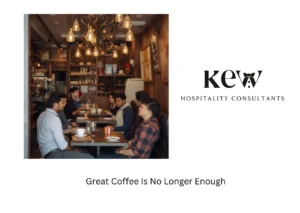

Many cafés invest heavily in coffee.
They invest in premium equipment, carefully sourced beans, beautiful interiors, and sophisticated branding. They spend months refining menus, selecting furniture, and perfecting their social media presence.
All of these things matter.
- Great coffee matters.
- Design matters.
- Equipment matters.
But none of them can compensate for weak leadership.
In hospitality, leadership is often the difference between a café that thrives and a café that merely survives.
Yet it remains one of the most overlooked investments in the industry.
When café owners discuss growth challenges, they often focus on external factors. Competition has increased. Costs are rising. Customer habits are changing. Footfall isn’t what it used to be.
While these challenges are real, many businesses plateau for a different reason.
The concept isn’t the problem.
The coffee isn’t the problem.
The location isn’t the problem.
The operation lacks structure, culture, and leadership.
Hospitality leadership is about far more than managing shifts and filling schedules.
It is about creating an environment where standards are maintained consistently, teams feel supported, and guests receive the same quality experience every time they walk through the door.
The reality is that customers experience leadership every day, even though they never see it directly.
They experience it through the attitude of the team.
They experience it through the consistency of service.
They experience it through cleanliness, efficiency, communication, and attention to detail.
Strong leadership creates consistency.
Weak leadership creates unpredictability.
And in hospitality, consistency is one of the most valuable assets a business can have.
A customer who enjoys a great experience once may return.
A customer who enjoys a great experience every time becomes loyal.
That level of consistency rarely happens by accident.
It happens because leaders establish expectations, communicate clearly, and create accountability throughout the operation.
The best café leaders understand that accountability is not about micromanagement.
It is about creating clarity.
Every team member should understand what success looks like.
They should understand service standards.
They should understand operational priorities.
Most importantly, they should understand how their role contributes to the overall guest experience.
When people understand the purpose behind their work, performance improves naturally.
This is where many operators get it wrong.
They spend significant time teaching employees what to do.
Far fewer spend time explaining why it matters.
Why does greeting a guest within seconds matter?
Why does maintaining a clean table matter?
Why does eye contact matter?
Why does speed of service matter?
When staff understand the impact of these actions on customer perception, they become more engaged in delivering them consistently.
Leadership is ultimately about creating belief.
The strongest café cultures are built when employees believe they are contributing to something meaningful rather than simply completing tasks.
Another critical responsibility of leadership is confidence building.
Hospitality environments can be demanding.
Busy periods create pressure.
Customer complaints create stress.
Unexpected challenges arise daily.
Without strong leadership, teams often become reactive.
With strong leadership, teams become resilient.
Great leaders create confidence by coaching rather than criticizing.
They provide feedback constructively.
They celebrate success.
They support development.
Over time, this creates teams that are capable of handling pressure without compromising standards.
Guests notice the difference immediately.
A confident team feels welcoming.
A confident team solves problems effectively.
A confident team creates positive energy throughout the café.
Perhaps most importantly, leadership protects the guest experience.
Every café owner wants excellent service.
But excellent service is not something that can be demanded.
It must be enabled.
The guest experience is the outcome of hundreds of small decisions made by team members throughout the day.
How quickly someone responds.
How professionally someone communicates.
How attentively someone listens.
How carefully someone prepares a product.
Leadership influences every one of these moments.
This is why some cafés with average locations outperform competitors in better locations.
It is why some businesses maintain loyal followings despite new competitors entering the market.
It is why customers often return for the people as much as they return for the coffee.
Strong leadership creates strong culture.
Strong culture creates strong teams.
Strong teams create exceptional guest experiences.
And exceptional guest experiences create sustainable business performance.
The most successful hospitality businesses understand this connection.
They know that investing in coffee equipment may improve product quality.
Investing in interior design may improve aesthetics.
Investing in marketing may increase awareness.
But investing in leadership improves everything.
It improves culture.
It improves service.
It improves retention.
It improves consistency.
It improves guest satisfaction.
In short, it improves the business itself.
As cafés continue to evolve into community spaces, workplaces, and social hubs, the importance of leadership will only increase.
The cafés that succeed in the future will not necessarily have the most expensive equipment or the trendiest interiors.
They will be the businesses that build strong teams, create positive cultures, and consistently deliver meaningful guest experiences.
And that starts with leadership.