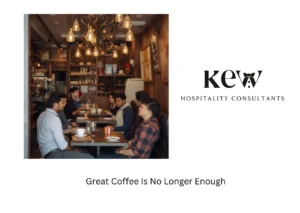

The role of cafés is changing rapidly.
Not long ago, most cafés were primarily transactional spaces. Customers would stop in for a quick coffee, perhaps a pastry, and then continue with their day. Success was often measured by speed of service, product quality, and volume of transactions.
While those factors remain important, the expectations of today’s customers have evolved significantly.
Cafés are no longer simply places to buy coffee.
They have become part office, part meeting point, part social hub, and part personal retreat.
For many people, cafés now serve a purpose that neither home nor the workplace can fully provide. This shift has given rise to what urban planners and hospitality professionals often refer to as the “third space.”
Home is the first space.
Work is the second.
Increasingly, cafés are becoming the third.
This evolution presents both a challenge and an opportunity for operators.
The businesses that continue to view themselves solely as coffee retailers risk missing the bigger picture. Those that embrace their role as hospitality venues have the opportunity to create stronger customer loyalty, higher spend per visit, and deeper connections with their communities.
The concept itself is not entirely new.
People have always sought gathering places outside of home and work. Historically, these spaces included town squares, community halls, libraries, and local pubs. Today, cafés have naturally stepped into that role.
The modern customer may visit a café for a coffee, but often stays for much more.
Some arrive with laptops and spend several hours working remotely. Others meet friends, hold informal business meetings, study for exams, read a book, or simply enjoy a change of environment.
This shift fundamentally changes how café operators need to think about their businesses.
Seating strategy becomes far more important.
In a traditional transactional model, turnover is everything. The objective is often to maximize the number of customers passing through the space.
In a third-space model, operators must balance turnover with comfort and dwell time. Different seating arrangements serve different purposes. A customer working for three hours may require a completely different environment than a group meeting for lunch or a guest stopping in for a takeaway coffee.
The most successful cafés deliberately design a variety of seating options to accommodate these different needs.
Noise levels also become a strategic consideration.
A completely silent environment can feel uncomfortable and lacking in energy. Excessive noise can make conversation difficult and discourage longer visits.
Finding the right balance requires careful consideration of acoustics, music, layout, and customer flow.
The atmosphere should feel vibrant without becoming overwhelming.
Technology has also become a critical part of the customer experience.
Reliable Wi-Fi is no longer viewed as a bonus feature. For many customers, it is an expectation.
The same applies to power access.
A customer looking to work remotely is unlikely to choose a café where charging a laptop or mobile device is difficult. Small operational details such as conveniently located power outlets can significantly influence where customers choose to spend their time.
Comfort has become equally important.
Customers who spend longer periods in cafés notice details that may have once been overlooked.
Chair comfort matters.
Table height matters.
Lighting matters.
Temperature matters.
Even the spacing between tables can influence how guests perceive the experience.
These considerations have long been central to hotel design and hospitality strategy. Increasingly, they are becoming essential components of successful café operations as well.
What makes this trend particularly interesting is that it shifts the focus from transactions to relationships.
Traditional retail thinking often revolves around driving footfall and increasing purchase frequency.
Hospitality thinking goes further.
It focuses on creating experiences that encourage guests to return because they genuinely enjoy being there.
This distinction is important because the strongest café brands today are not simply building customer bases.
They are building communities.
A community is fundamentally different from a customer list.
Customers buy products.
Communities develop emotional connections.
Customers can be attracted by discounts.
Communities return because they feel a sense of belonging.
This is why some independent cafés consistently outperform larger competitors despite having fewer resources or locations. Their success is often rooted in the experience they create and the relationships they cultivate.
People know the staff.
Staff know the regulars.
The café becomes woven into daily routines and local culture.
That sense of familiarity and connection is incredibly difficult to replicate through pricing strategies alone.
As competition within the café sector continues to increase, operators must recognize that coffee quality, while essential, is no longer enough on its own.
The future belongs to businesses that understand they are operating hospitality venues, not simply beverage outlets.
The most successful cafés will be those that create environments where people want to spend time, connect with others, work, relax, and feel comfortable.
In an increasingly digital world, physical spaces that foster human connection have become more valuable than ever.
The cafés that embrace their role as the modern third space will not only attract customers.
They will build communities.
And community creates a level of loyalty that no discount programme can ever match.